
The modern workplace is undergoing a profound structural transformation.
Across industries, large employers are quietly rewriting the organizational chart, eliminating layers of middle management to accelerate decision-making and reduce costs. This trend, often referred to as the “Great Flattening,” is fundamentally reshaping the role of the manager.
For Human Resources (HR) and Organizational Development (OD) leaders, this shift requires urgent attention. While structural efficiency is a valid business goal, it cannot come at the expense of effective leadership.
Global data reveals a stark reality: managers possess an outsized, foundational influence on employee wellbeing, engagement, and retention.
As we increase their span of control and individual workloads, we risk breaking the most critical link in the organizational chain.
To build resilient, high-performing organizations, leaders must understand just how much a manager matters—and rethink how they select, develop, and support them.
The Outsized Influence of the Manager on Daily Life
It is easy to view managers simply as administrators of work—coordinators of schedules, approvers of budgets, and evaluators of performance. However, psychological data reveals they are much more.
In a massive global study by Gallup encompassing over 30,000 adults across 52 countries, individuals were asked to name the leader who has the most positive influence on their daily lives.
Strikingly, 34% of employed people named a workplace leader—such as a manager or organizational leader.
To put this in perspective, workers are nearly as likely to cite a leader from their work environment as their greatest daily positive influence as they are to name a family member (44%). In some nations, this reliance on workplace leadership is staggering; in China, 70% of people named a workplace leader, followed by 60% in Germany and 52% in the UAE.
What are these followers seeking?
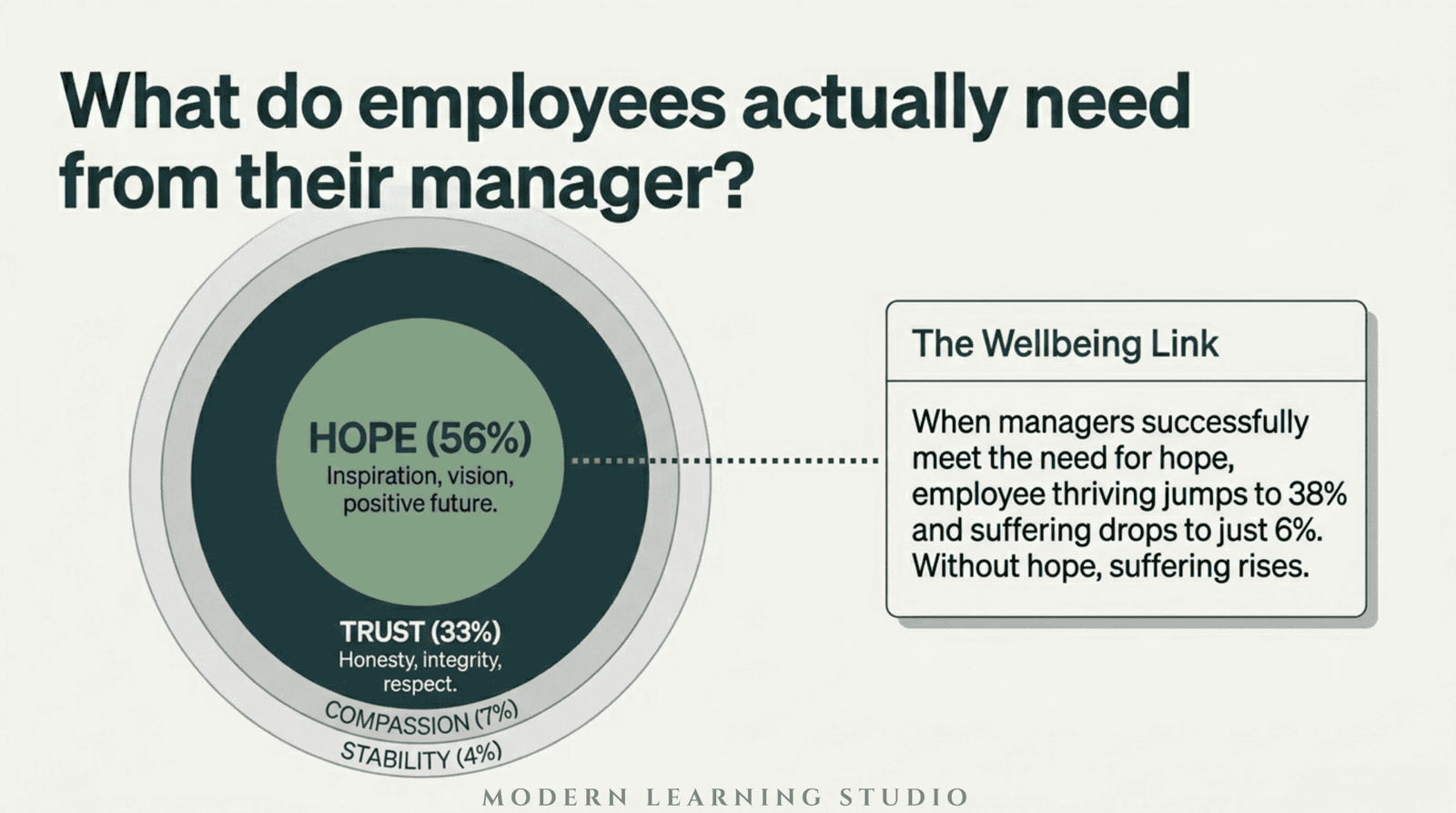
The research identifies four universal needs: Hope, Trust, Compassion, and Stability. Hope is the dominant need, accounting for 56% of all attributes linked to influential leaders.
When managers fulfill these needs, they profoundly affect employee life evaluation. When a leader provides hope, the percentage of employees who are “thriving” rises to 38%, and those who are “suffering” drops to just 6%.
Conversely, when these needs are unmet, suffering increases.
Your managers are not just driving productivity; they are actively shaping the human condition of your workforce.
The Connection to Engagement and Retention
The quality of management is inextricably linked to how engaged employees are and whether they choose to stay with the organization.
Today, employee engagement is in a precarious state.
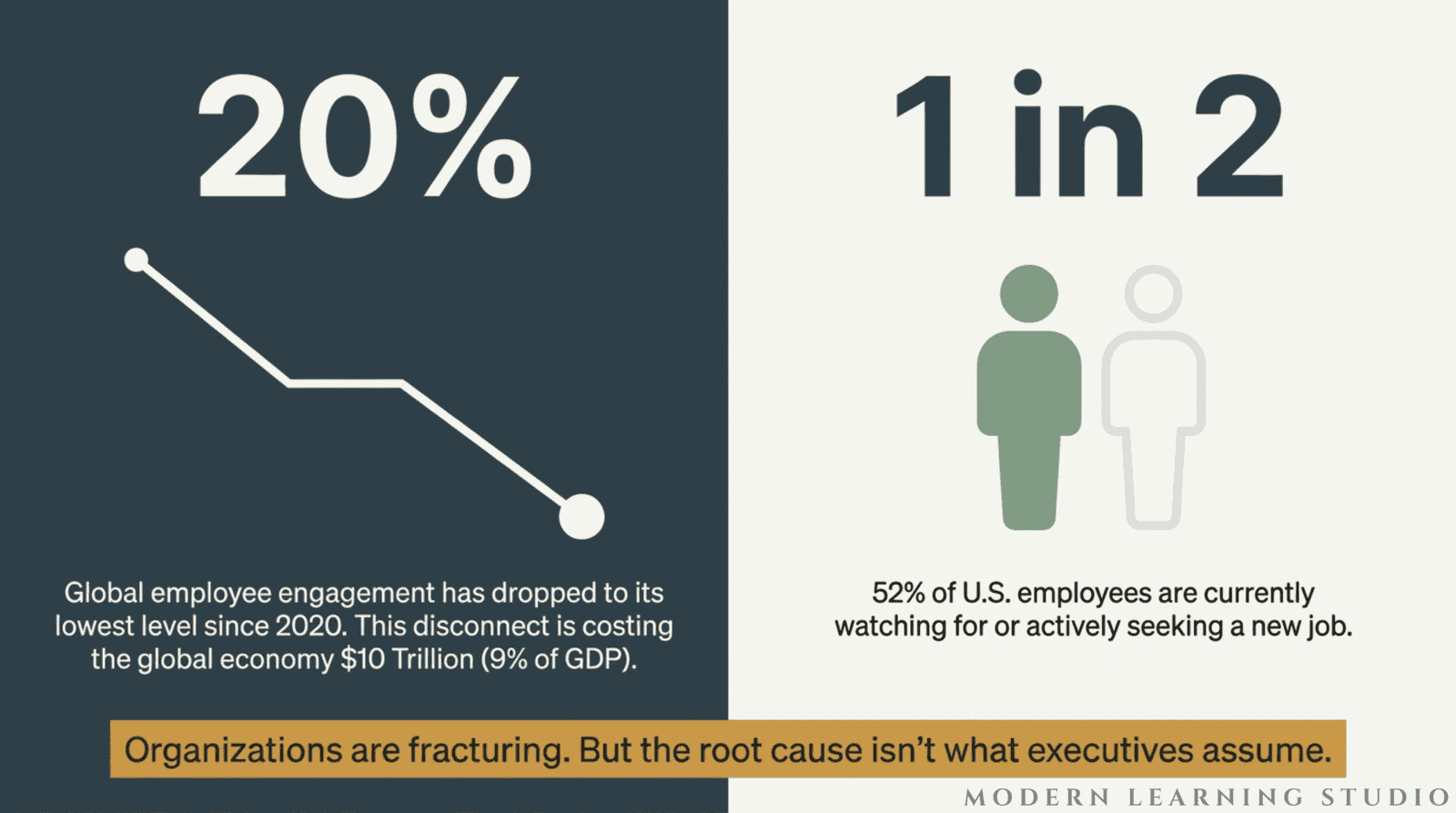
In 2025, global employee engagement declined to 20%, costing the world economy approximately $10 trillion in lost productivity. In the U.S., engagement sits at just 31%.
When engagement plummets, turnover inevitably follows.
Currently, 52% of U.S. employees are watching for or actively seeking a new job.
When organizations analyze why people leave, they frequently point to compensation.
However, the data tells a different story.
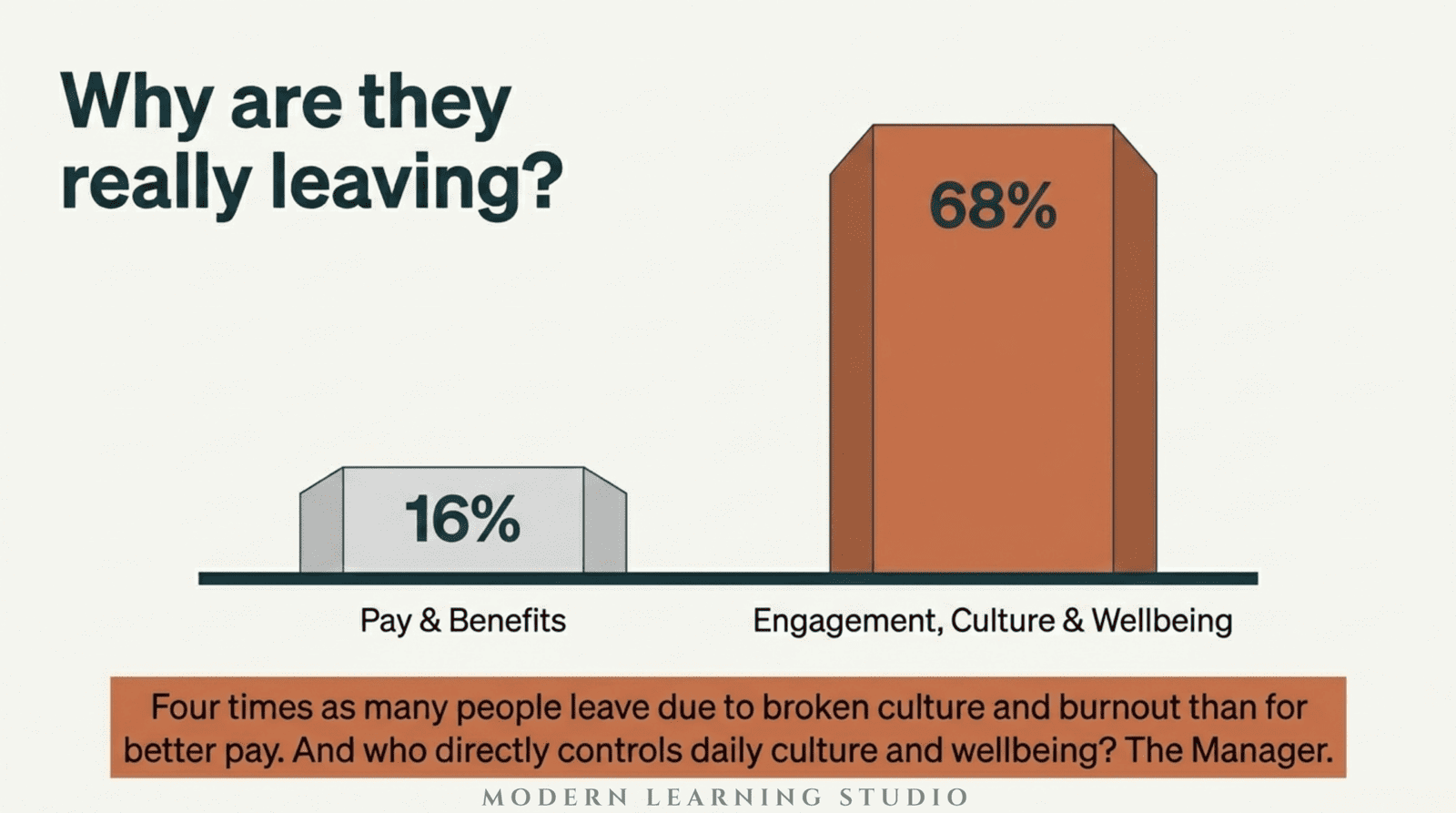
While 16% of U.S. employees voluntarily leave for better pay and benefits, a staggering 37% leave due to issues related to “Engagement and Culture,” and another 31% leave because of “Wellbeing and Work-Life Balance”.
Combined, these two categories account for 68% of all voluntary turnover.
Why does this matter?
Because engagement, culture, and day-to-day wellbeing are almost entirely mediated by the direct manager. If an employee lacks advancement opportunities, faces unrealistic job expectations, or suffers from poor work-life balance, these are failures of management and job design.
When attracting new talent, 60% of employees state that greater work-life balance and better personal wellbeing are “very important” in their next job, and 48% want a role that allows them to do what they do best. A manager is the single greatest variable in delivering on this employee value proposition.
The Squeeze on Managers: Span of Control and Burnout
If managers are the linchpin of the employee experience, organizations must face a deeply concerning trend: managers are burning out, and their own engagement is plummeting.
The global decline in engagement is most acute among managers.
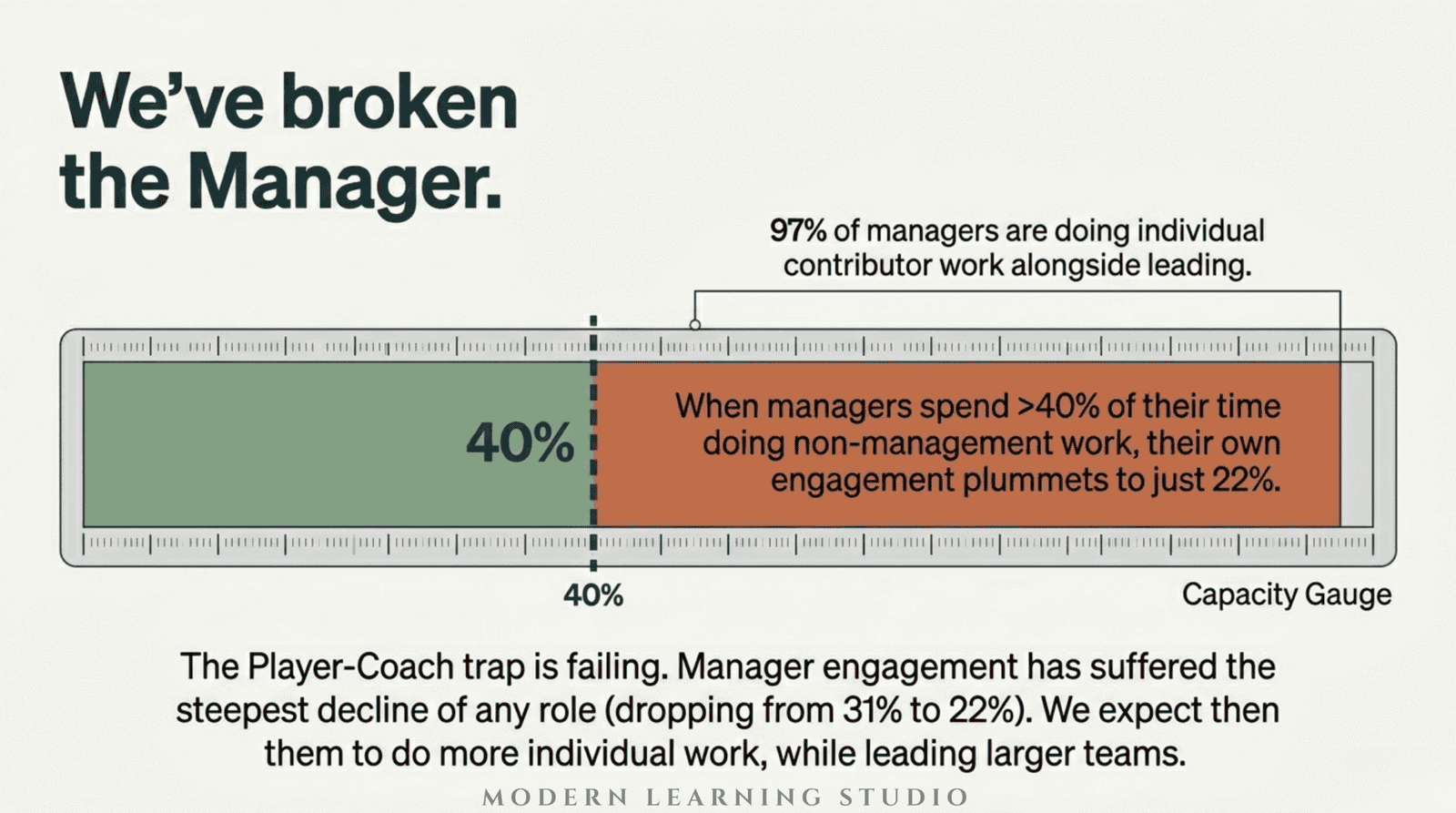
Manager engagement fell from 31% in 2022 to just 22% in 2025.
This drop is driven by the structural pressures of the “Great Flattening.”
In the U.S., the average manager’s span of control—the number of direct reports they oversee—has increased to 12.1 in 2025, a nearly 50% increase in team size since 2013.
Simultaneously, 97% of managers act as “player-coaches,” meaning they have individual contributor responsibilities on top of their leadership duties.
Managers spend a median of 40% of their time on individual work.
When managers exceed this 40% threshold, their engagement drops significantly, and it worsens as their team size grows.
Organizations cannot expect managers to provide hope, compassion, and continuous development if those managers are stretched hopelessly thin. Widening spans of control without reducing managers’ individual workloads risks weakening day-to-day performance management by compromising the managers’ own performance.
Implications for Leadership Development
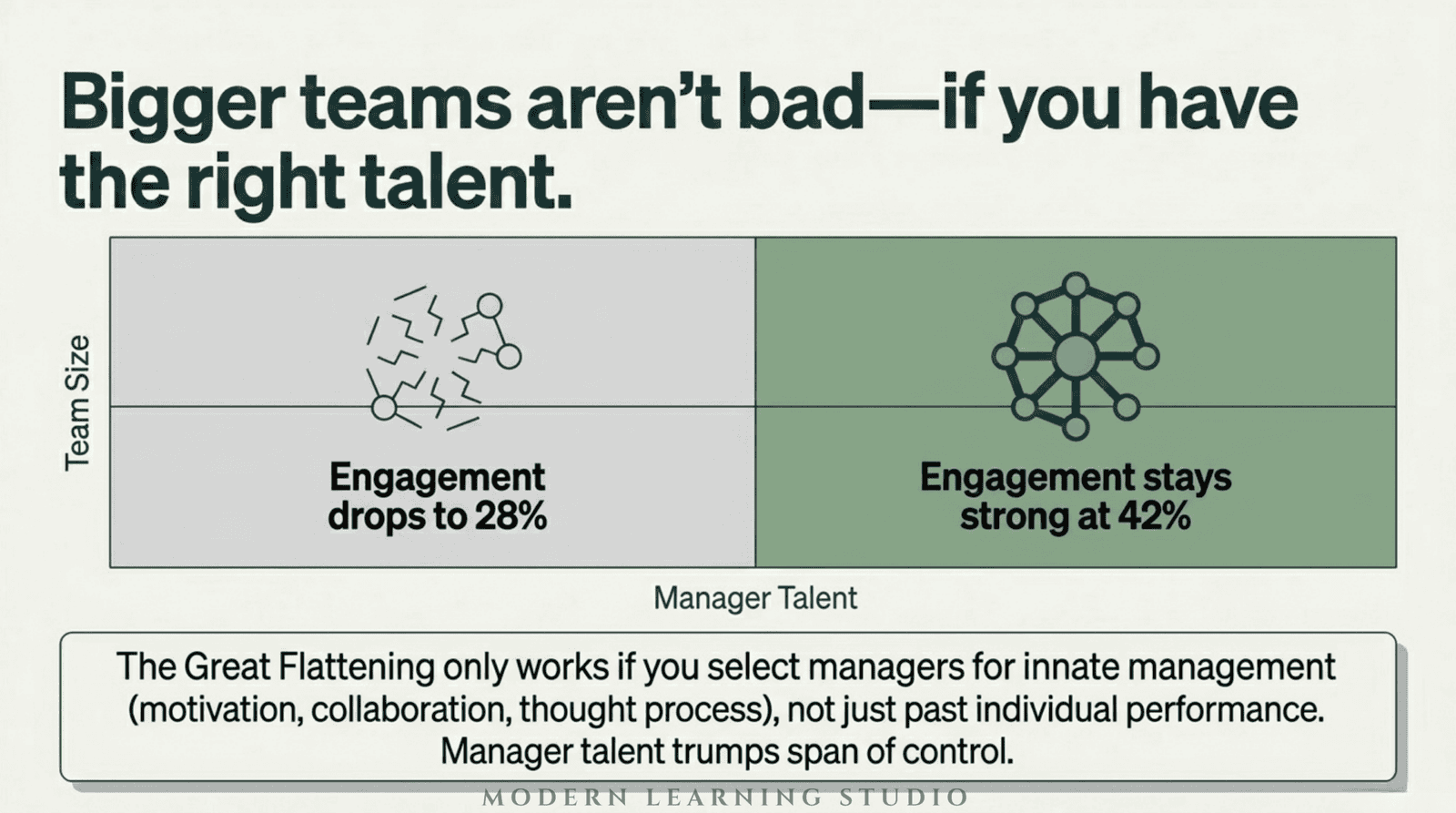
The solution is not necessarily to universally shrink team sizes, but rather to recognize that managing a larger team requires specific innate talents and fundamentally different leadership habits.
1. Talent Trumps Span of Control
Not everyone is equipped to manage a team of 15 people. Gallup has identified five key traits of successful managers: motivation, workstyle, initiation, collaboration, and thought process. When faced with very large teams (25+ direct reports) and heavy individual contributor workloads, people with high management talent actually maintain higher engagement, whereas those with medium or low talent see their engagement crater. Organizations must stop promoting based solely on tenure or individual performance and use scientific methods to identify leadership talent.
2. The Power of Meaningful Feedback
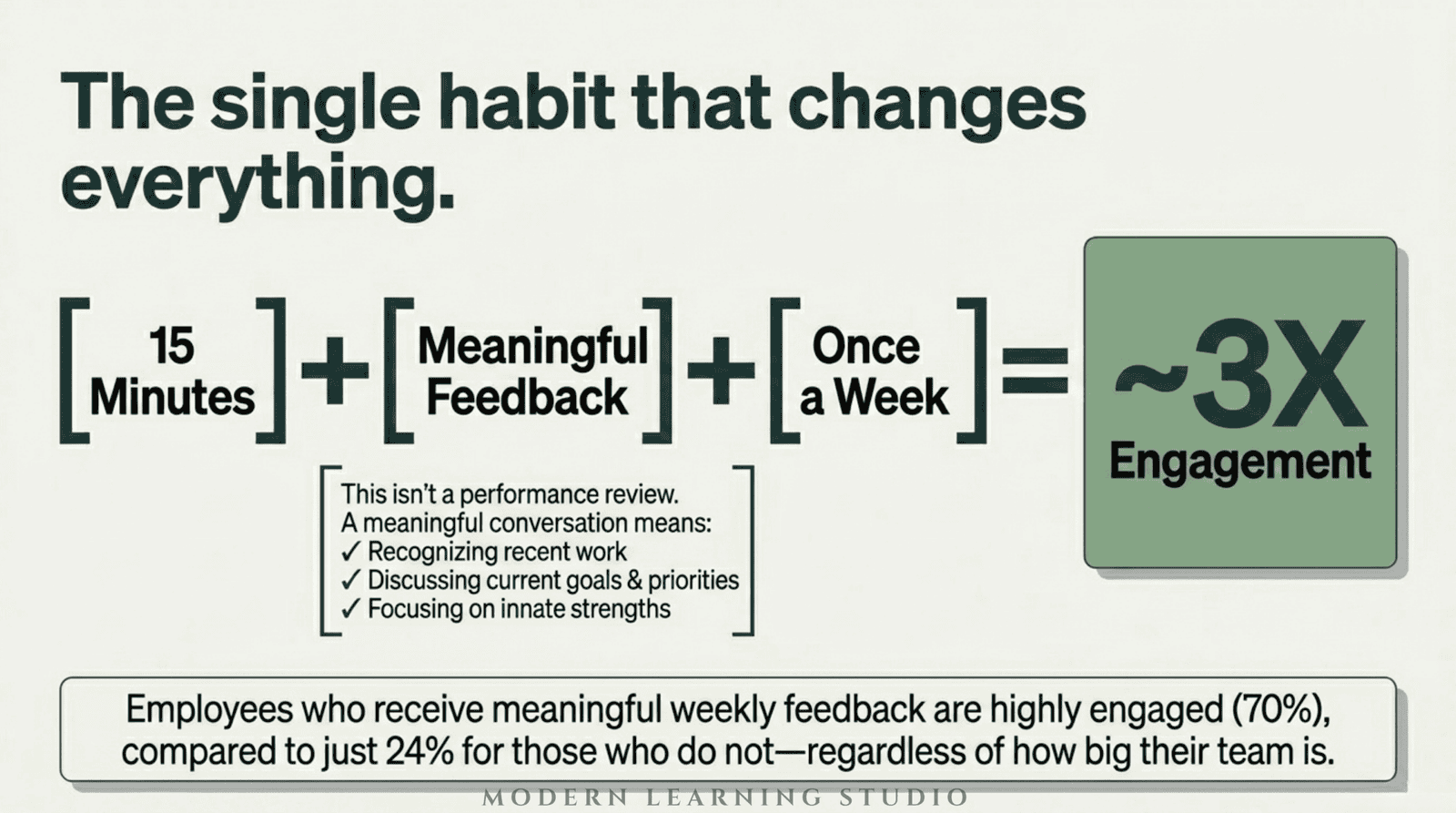
The single most effective habit a manager can deploy is providing meaningful feedback to each employee at least once per week. This simple practice nearly triples the percentage of engaged employees, regardless of team size. Meaningful feedback doesn’t need to be a formal hour-long review; 15 to 30 minutes focused on recognition, collaboration, goals, and strengths is enough. Yet, it is alarmingly rare: only 16% of employees report that their last conversation with their manager was extremely meaningful.
Recommendations for Organizations
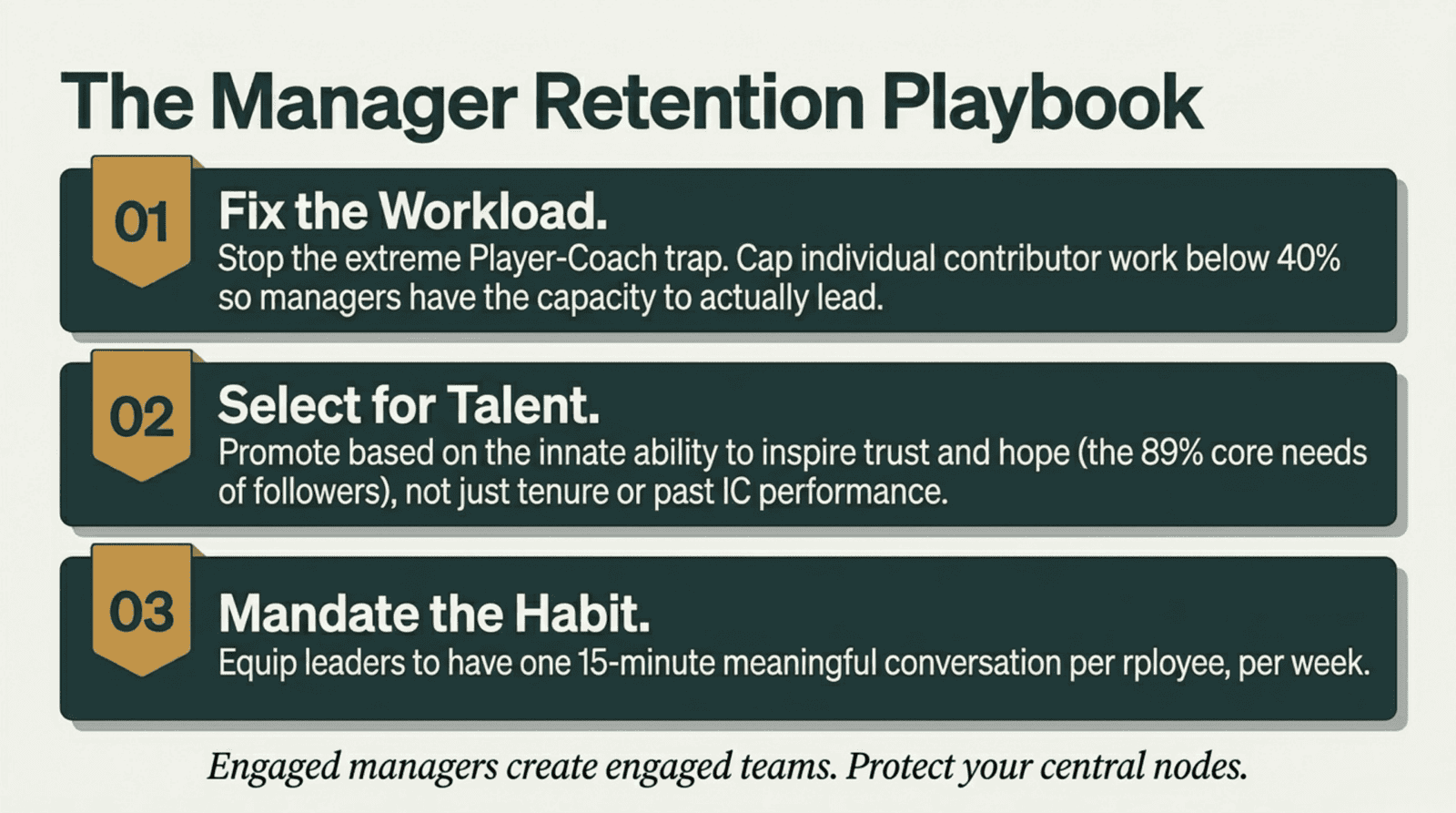
To harness the true power of your managers and reverse the trends of disengagement and turnover, HR and organizational leaders must adopt a new playbook:
- Redefine the Player-Coach Balance: Audit the workloads of your managers. Do not expect leaders to manage a team of 12 people while still dedicating 60% of their time to individual contributor tasks. You must protect their capacity to coach.
- Institutionalize Weekly Feedback: Make weekly, meaningful feedback an expected, non-negotiable practice. Provide managers with the frameworks, tools, and training to hold short, high-quality, strengths-based conversations with their direct reports.
- Select for Innate Leadership Talent: If you are flattening your organization and expanding spans of control, you must be rigorous about who you place in management roles. Use validated assessments to identify those with the natural capacity to inspire and organize large groups.
- Measure Engagement at the Team Level: Treat manager and team engagement as leading indicators of business health. Track how performance and wellbeing fluctuate as spans of control grow, and intervene when a manager’s engagement begins to slip.
Conclusion
The data is unequivocal: your managers matter more than you think. They are the primary conduit through which employees experience your organization’s culture, vision, and stability. They hold the keys to employee wellbeing, the levers of engagement, and the anchor for retention. As the workplace continues to evolve, organizations that treat management as a profound responsibility—rather than an administrative burden—will be the ones that attract top talent, cultivate hope, and thrive.