

You Hold More Power Than You Think
Ask who controls the mood in a room, and most people point to the loudest voice or the angriest person. The answer may be less obvious: it could be the quiet one, the person working hardest to keep everyone calm.
If that sounds familiar, there is good news in it.
Peacekeeping is a skill, not only a kindness
Some people scan a room before they speak. They notice who is tense, anticipate reactions, adjust their tone, and smooth things over before a disagreement can take shape. From the inside, this usually feels like giving, and often it is.
It is also something else. Reading people, predicting responses, and adapting in order to influence what happens next is a set of skills, practiced over years. A person who does this is not controlling everyone in the room, but neither are they passive. They are participating in the dynamic far more actively than they may realize.
That is real influence. It rarely feels like power because it presents itself as consideration.
What the pattern gives back
Any long-running pattern tends to pay something back, or it would not last. For the peacekeeper, the returns can include:
- Safety, because a calm room feels like a safe room.
- Being needed, and the sense of belonging that comes with it.
- Being the easy one, or the good one.
- Never being the cause of conflict.
- Control, or at least a sense of steering the outcome.
Naming these payoffs is not an accusation, and it does not make the generosity less real. Care and self-protection can operate in the same act. Seeing both simply gives a more complete picture than “I give and give.”
Scripts we inherit
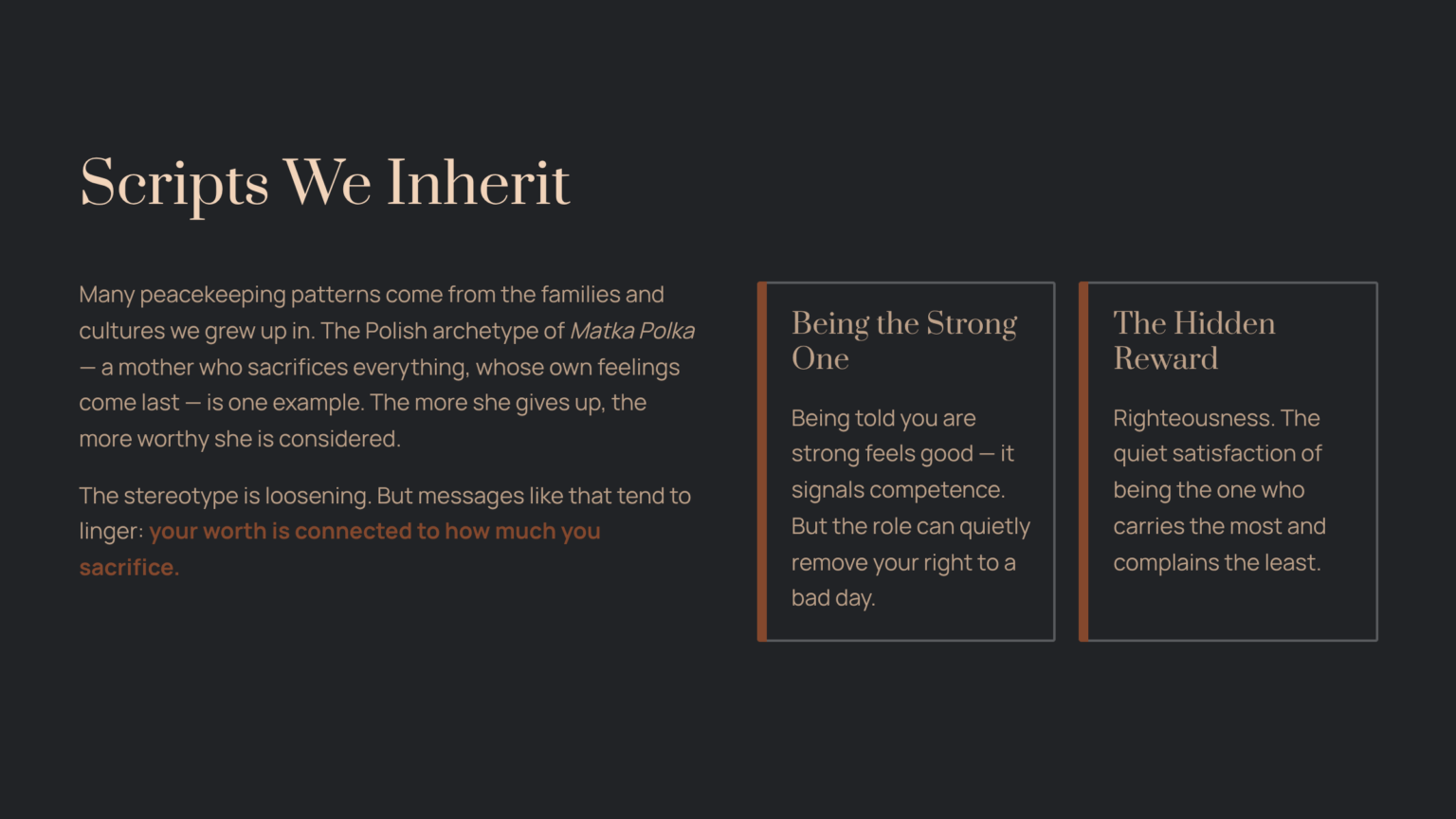
Some of these payoffs come from the culture and family a person grew up in. In Poland, the Matka Polka, or Polish Mother, is a familiar archetype: a woman who sacrifices everything for her family and whose own feelings come last. In that version, the more she gives up, the better a woman she is considered to be. The stereotype is loosening, but a message like that tends to linger: your worth is connected to how much you sacrifice. Many families and cultures have their own variation, and one of its hidden rewards is the feeling of righteousness that comes from being the one who carries and gives.
A related identity is being the strong one. Being told you are strong feels good. It signals competence and reliability. But the role can quietly remove the right to a bad day, since everyone has come to count on you not having one. It can be fulfilling, and exhausting, at the same time.
Seeing your part is not the same as being at fault
If someone sees themselves only as the one who gives, they are left absorbing a cost they cannot explain or change. Asking what the pattern also provides adds information, and information creates options.
None of this means the situation is your fault. It means you are taking part in something you can finally see. From there, better questions become available:
- How else could I feel safe?
- How else could I feel needed?
- How else could I feel strong?
- How could I live by my values without constantly sacrificing myself?
Nothing here requires giving up strength. It is possible to be strong and have a bad day.
Why memory needs receipts
Seeing a pattern is harder than it sounds, because memory is a poor witness. It edits, softens, and sometimes buries what was painful. A journal is a more reliable record. Even an inconsistent one can show how often something happened and how much was tolerated along the way. Patterns also tend to begin earlier than the story we later tell about them.
Journaling pairs well with the audience-seat exercise from Watch Your Life Like You’re the Audience. Replay a situation from the outside, then add one question: What was my character getting out of this? Safety? Control? Being needed? Being the good one, the strong one, the one who sacrificed? The aim is not blame. It is information.
A ten-second experiment
This week, find one moment where you would normally smooth things over immediately, and don’t. Let the room stay a little uncomfortable for ten seconds. Then notice what you feel, what you want to do, and whether your instinct is to jump back in and manage everything again.
Whatever happens is data, not a verdict.
The goal is not to care less about people. It is to understand what you are doing, what you receive from it, and whether you still want to keep paying the same price.
Explore it visually
These visual reflections look at the hidden payoffs of keeping the peace, the scripts we inherit, and the choices that open up once a pattern becomes visible.
← Previous Post: Are You Being Kind, or Abandoning Yourself?




Watch the conversation
The companion Applied Curiosity Studio video takes a more personal, conversational approach to this subject.